.svg)
Dental Implants in South Barrington, IL
Titanium dental implants for single-tooth, multiple-tooth, or full-arch replacement. Planned with 3D Cone Beam imaging and computer-guided surgical technique.
.svg)
Dental Implants in South Barrington, IL
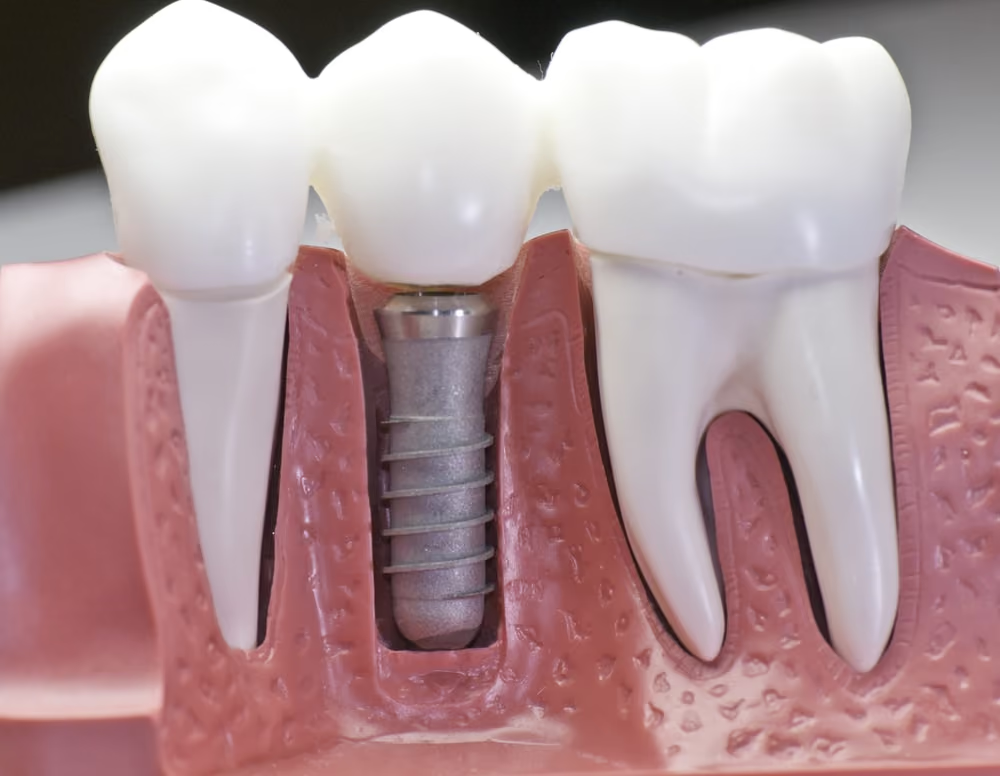
A dental implant is the closest thing modern dentistry offers to a natural tooth. A titanium post is placed in the jaw to replace the root of a missing tooth, then a custom crown, bridge, or denture is attached on top. The implant fuses with the jaw bone over several months and functions like a natural tooth root, providing stability, preserving bone, and restoring normal chewing function. At South Barrington Dental Care, we plan every implant case with 3D Cone Beam CT imaging and, when appropriate, computer-guided surgical guides for precise placement.
Implant dentistry has become the standard of care for many single-tooth replacement cases because of the long-term advantages: implants preserve jaw bone in the missing-tooth area, avoid compromising adjacent teeth (as a bridge does), and typically last longer than any other tooth replacement option. For patients missing multiple teeth or full arches, implant-supported bridges and overdentures offer transformative improvements in function and quality of life.
What a Dental Implant Is
A dental implant has three components:
- The implant itself: A titanium or titanium-alloy post that replaces the tooth root and fuses to the jaw bone
- The abutment: A small connector attached to the implant that supports the restoration
- The restoration: A custom crown, bridge, or denture attached to the abutment
Over 3-6 months, the implant undergoes osseointegration, a process by which bone grows directly onto the implant surface, creating an extremely stable foundation.
Benefits
- Closest to a natural tooth in function and feel
- Long-lasting (often lifetime with proper care)
- Preserves jaw bone in the missing-tooth area
- Does not compromise adjacent teeth (unlike bridges)
- Restores full chewing function (dentures only restore partial function)
- Natural-looking crown or restoration
- Prevents drift of adjacent teeth
- Supports full-arch restorations for patients missing most teeth
- Stable support for implant overdentures
Types of Implant Cases We Perform
- Single-tooth implant: Replaces one missing tooth with an implant and a custom crown
- Multiple-tooth implants: Replaces several missing teeth with individual implants or implant-supported bridges
- Full-arch replacement: 4-6 implants supporting a fixed bridge or overdenture for patients missing all teeth in an arch
- Implant overdentures: 2-4 implants supporting a removable denture for dramatically better stability
The Implant Process Step by Step
Step 1: Consultation. Dr. Allison Bartley reviews your medical history, current medications, and specific dental situation.
Step 2: 3D Cone Beam Imaging. A CBCT scan provides precise 3D information about bone volume, nerve positioning, and sinus location.
Step 3: Digital Planning. The implant is positioned virtually before surgery, accounting for the planned restoration.
Step 4: Surgical Guide (when indicated). A custom 3D-printed guide ensures precise placement.
Step 5: Placement. The implant is placed under local anesthesia (or IV sedation for anxious patients). Most single-implant procedures take 30-60 minutes.
Step 6: Healing. 3-6 months of osseointegration before the final restoration is placed. During this time you may wear a temporary.
Step 7: Abutment and Impression. After healing, the abutment is placed and an impression is taken for the final restoration.
Step 8: Restoration. A custom crown, bridge, or denture is fabricated and attached.
Step 9: Follow-Up. Regular checkups ensure the implant and surrounding tissue remain healthy.
Timeline
- Consultation and planning: 1-2 visits
- Implant placement: 60-90 minutes
- Healing/osseointegration: 3-6 months
- Bone grafting (if needed): Adds 4-6 months
- Final restoration: 2-3 visits after healing
- Total timeline: 4-9 months from placement to final restoration
- Implant lifespan: Often a lifetime with proper care
Cost Factors
Single-tooth dental implants with crowns typically run several thousand dollars. Multi-tooth and full-arch cases cost more. Many PPO dental insurance plans cover a portion of implant treatment; some specifically exclude implants.
Cost depends on:
- Number of implants needed
- Type of restoration (single crown vs. bridge vs. full arch)
- Whether bone grafting is required
- Complexity of placement
- Materials selected
We provide detailed written estimates before treatment. CareCredit financing are available. See our finance and insurance page.
Risks and Limitations
Healing time. Implants require 3-6 months to integrate with bone before final restoration.
Need for bone grafting. Patients with significant bone loss may need grafting to create adequate implant support.
Surgical risks. As with any surgical procedure: infection, bleeding, nerve injury (rare with 3D planning), sinus involvement (for upper posterior implants).
Implant failure. Approximately 2-5% of implants fail to integrate. Failed implants can usually be replaced after healing.
Peri-implantitis. An inflammatory condition similar to gum disease that can affect implants. Regular cleanings and good home care prevent this.
Not appropriate for all patients. Uncontrolled diabetes, certain bone medications (some bisphosphonates), and heavy smoking are relative contraindications.
Who Is a Good Candidate
- Adults missing one or more teeth
- Patients with adequate bone volume (or candidates for bone grafting)
- Patients in reasonable general health
- Non-smokers or patients willing to quit during healing
- Patients committed to good home care and regular dental visits
Who Is NOT a Good Candidate
- Patients with uncontrolled diabetes (control first)
- Patients on certain bisphosphonate medications for osteoporosis (requires careful evaluation)
- Heavy smokers (higher failure rate)
- Patients with severe periodontal disease (treat first)
- Patients with inadequate bone and unwilling or unable to receive grafting
- Adolescents whose jaw growth is incomplete
Comparison: Implant vs. Bridge vs. Denture
Dental Implant: Best long-term solution for missing teeth. Preserves bone. Does not compromise adjacent teeth. Longest lifespan. Highest initial cost but often best long-term value.
Dental Bridge: Fixed replacement. Faster than implants. Requires preparing adjacent teeth. 10-15+ year lifespan. Moderate cost.
Dentures: Removable. Lower cost. More dietary restrictions. Bone loss continues. Requires periodic replacement.
For most patients with a single missing tooth between healthy neighbors, an implant is the recommended option because it preserves those neighboring teeth and the underlying bone.
Alternatives
- Dental bridges when implants are not feasible
- Digital dentures for patients missing many teeth
- Implant overdentures for full-arch replacement
- Keeping existing teeth with preventive care when possible
Provider Authority
Dr. Allison Bartley plans every implant case with 3D Cone Beam CT imaging and computer-guided planning. The practice is equipped for surgical placement and restoration, which means you receive both phases of care from a team you already know. Complex cases (severe bone deficiency, proximity to critical structures, immediate load cases) may involve coordination with an oral surgeon or periodontist. Read about our technology.
Serving the Northwest Suburbs
Implant patients come from South Barrington, Inverness, Streamwood, Hoffman Estates, Palatine, Schaumburg, and Arlington Heights.

.svg)
.svg)
.svg)
Common Questions About Dental Implants
How long do dental implants last?
With proper care and regular dental visits, dental implants often last a lifetime. The crown on top of the implant may eventually need replacement after 15-20+ years, but the implant itself typically remains permanently integrated with bone.
Is implant placement painful?
Local anesthesia blocks pain during placement. Most patients report that placement is more comfortable than they expected. Post-surgical discomfort is usually mild and manageable with over-the-counter medication for 2-3 days.
Am I too old for implants?
There is no upper age limit for dental implants. Healthy patients in their 80s and 90s have successful implant treatment. What matters is overall health and bone quality, not age.
Can I get an implant the same day a tooth is extracted?
Sometimes. In select cases, an implant can be placed at the time of extraction (immediate placement). This depends on bone quality, infection status, and the specific tooth. We evaluate feasibility during consultation.
Does insurance cover dental implants?
Coverage varies widely. Some PPO plans cover a portion of implant treatment (typically 50% after deductible up to annual maximum). Some plans specifically exclude implants. We verify benefits during consultation.
South Barrington Dental Care has been serving patients in the Northwest Suburbs of Chicago for years and has built a strong local reputation for comprehensive, patient-centered care. Dr. Allison Bartley leads the practice and the all-female clinical team.
Schedule An Implant Consultation at South Barrington Dental Care
Serving patients across South Barrington, Inverness, Streamwood, Hoffman Estates, Palatine, Schaumburg, and Arlington Heights.