.svg)
The Small Cost of OralID Could Be One of the Best Investments You Make in Your Oral Health
When most people visit the dentist, they're thinking about cavities, cleanings, crowns, or keeping their smile looking great.
.svg)
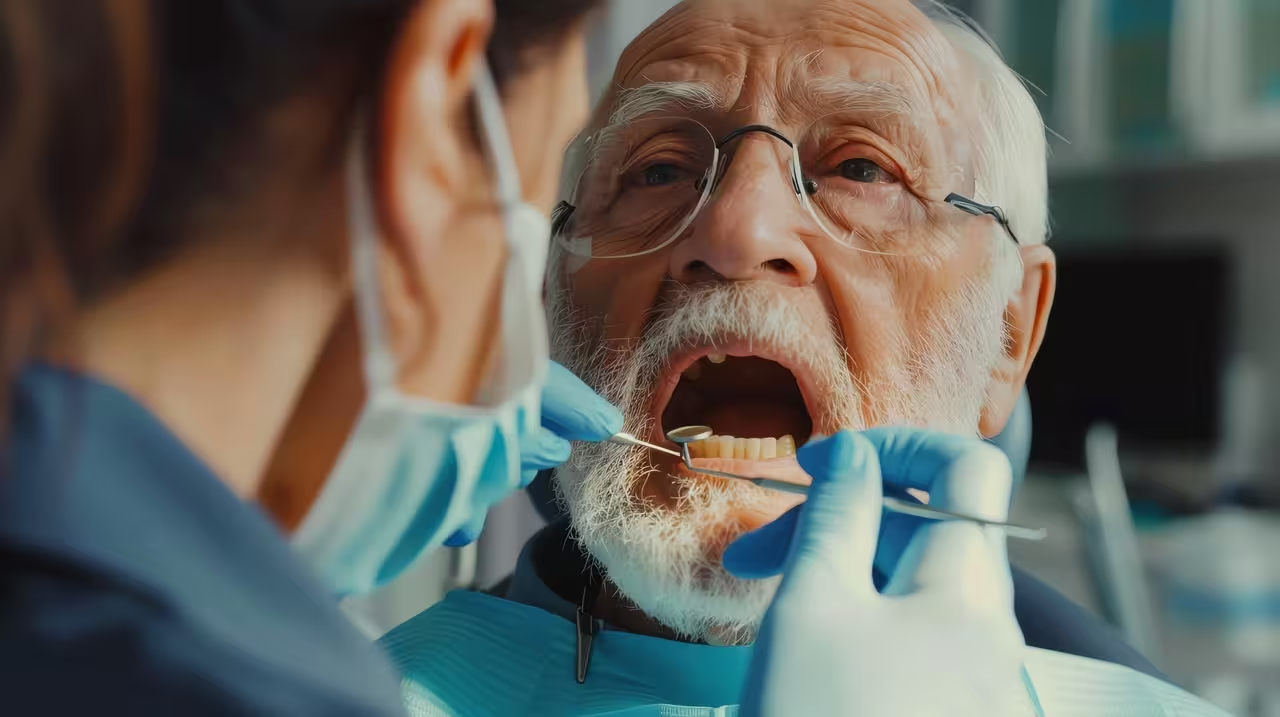
A few extra minutes of careful examination can provide valuable information about the health of the tissues in your mouth.
When most people visit the dentist, they're thinking about cavities, cleanings, crowns, or keeping their smile looking great.
But one of the most important things we look for has nothing to do with your teeth.
We're also looking for signs of oral cancer.
And because oral cancer can begin with very subtle changes - sometimes without pain or obvious symptoms - finding something unusual as early as possible matters.
Oral Cancer Is More Common Than Many People Realize
The American Cancer Society estimates that approximately 60,480 Americans will be diagnosed with oral cavity or oropharyngeal cancer in 2026, and approximately 13,150 people will die from these cancers.
One of the challenges with oral cancer is that an early abnormality may be easy for a patient to overlook. It might appear as a small red or white area, a sore that doesn't heal, a lump, thickened tissue, or another subtle change.
Some cancers and precancerous changes are discovered during routine dental examinations - before the patient ever knew something was wrong.
That is one reason we take oral cancer examinations seriously.
Earlier Detection Can Make an Enormous Difference
Cancer discovered before it has spread generally has a much better outlook than cancer discovered after it has advanced.
For cancers of the floor of the mouth, five-year relative survival is approximately 72% when localized versus 22% when distant. Survival statistics describe groups of people and cannot predict an individual outcome.
Those numbers are why we'd much rather investigate something early and discover that it is harmless than overlook something important.
What Is OralID?
At South Barrington Dental Care, we have the ability to add OralID enhanced visualization to an oral examination.
OralID uses a special blue light and fluorescence technology to help the clinician visualize oral tissues and identify areas that may look different from the surrounding healthy tissue.
- Quick
- Non-invasive
- Painless
- Radiation-free
- Performed right in the dental chair
There are no needles and no uncomfortable procedure involved.
Most importantly, OralID is not a cancer diagnosis and it does not replace a thorough visual and tactile oral cancer examination. If we discover an area that concerns us, additional evaluation - and sometimes referral or biopsy - may be necessary.
Think of OralID as another visualization tool that can be used alongside the clinical examination.
'But I Don't Smoke.'
That's great - but it doesn't mean oral cancer isn't worth thinking about.
Tobacco and heavy alcohol use remain important risk factors, but oral and oropharyngeal cancers can occur in people who have never smoked. HPV is also associated with many cancers of the oropharynx, and rates of oral cavity and oropharyngeal cancers have been rising in recent decades, driven in part by HPV-related disease.
That means oral cancer awareness isn't simply for smokers or older adults. It's relevant to everyone.
Consider What You Spend to Protect Other Things
We routinely spend money protecting things that are important to us.
We insure our cars.
We protect our phones.
We change the oil in our vehicles before the engine develops a problem.
We have mammograms, colonoscopies, skin checks, blood tests, physicals, and other preventive examinations because we understand a simple principle:
Finding a problem early is usually better than finding it late.
Your mouth deserves the same attention.
For the relatively small cost of adding OralID enhanced visualization to your examination, we believe it can be a worthwhile investment in your oral-health awareness - not because OralID can tell us that you have cancer, but because taking a few extra moments to look carefully for something unusual can be valuable.
A Few Minutes. A Small Cost. Potentially Important Information.
We hope your OralID examination shows absolutely nothing concerning. That's the result we want every single time.
But if there ever is an unusual area in your mouth, we'd rather notice it today than months from now.
That's why we offer OralID.
When You're Here, Ask Us About Your Oral Cancer Screening.
At South Barrington Dental Care, we're not only taking care of your teeth.
We're looking after the health of your entire mouth.
Sometimes, the most valuable part of a dental visit may be something you never realized we were looking for.
Clinical Note
OralID is an adjunctive visualization device, not a diagnostic test. Current American Dental Association guidance emphasizes routine visual and tactile examination and does not recommend relying on light-based adjuncts to determine the need for biopsy/referral or as a replacement for the conventional clinical examination. Suspicious findings require appropriate clinical evaluation and, when indicated, biopsy or specialist referral.
Sources
%20(1).avif)
Ready to experience thoughtful, modern dentistry?
Schedule your visit with South Barrington Dental Care today. New patients are always welcome.
.svg)
.svg)